You can watch this talk on YouTube in Russian and English(auto-dubbed).
The presentation is available here.
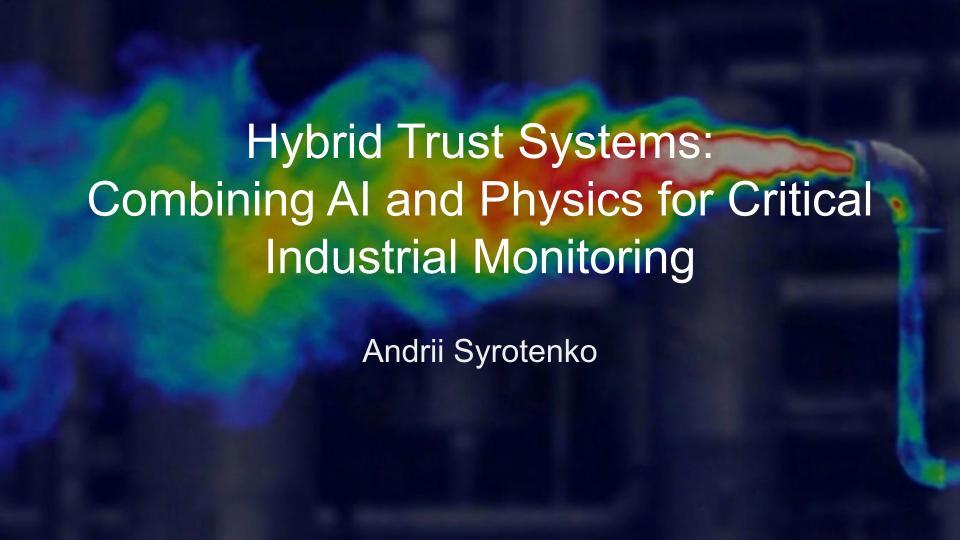
Andrii Syrotenko’s presentation addressed one of the most important questions in industrial AI: what do you do when AI alone is not trustworthy enough for critical environments? Drawing on experience from industrial analytics and computer vision in oil and gas, manufacturing, and aviation-related systems, he showed why real-world industrial monitoring cannot rely purely on model confidence scores or lab-trained behavior.
A major part of the talk focused on the challenge of false positives in real industrial settings. Even strong computer vision models can perform well in controlled environments and still fail once they are exposed to changing weather, lighting, reflections, steam, background interference, or production-specific visual noise. In gas detection, for example, steam can resemble gas in spectral imagery; glare and reflections can trigger false alarms; and in manufacturing, even something as simple as an oil drop can be misclassified as a crack or defect. In critical infrastructure, those false positives are not merely inconvenient — they can stop production, overwhelm operators, and ultimately reduce trust in the system.
That issue led directly to the core idea of the session: hybrid trust systems. Instead of depending on AI alone, Andrii described how his teams introduced a second validation layer based on physics and motion analysis. After the AI system detects a possible event, a lightweight physics-based pipeline checks whether the event is physically plausible. This includes tracking motion vectors across frames, analyzing optical flow, looking at direction and speed, and comparing what is observed against known physical behavior. For example, vapor rises in a certain way, gases do not move at impossible speeds, and certain visual artifacts behave differently from actual leaks or defects. When those physical constraints contradict the AI prediction, the confidence can be reduced before the alert reaches an operator.
Another important point in the talk was that many industrial environments are constrained in ways typical cloud AI systems are not. These systems often run with limited hardware, restricted connectivity, and little or no internet access for security reasons. Models cannot always be continuously retrained in production, and organizations are often unable or unwilling to share sensitive operational data. Because of that, it is not realistic to assume that more data or more retraining will solve every problem. In such environments, combining AI with domain physics is not just elegant — it is practical.
During the discussion, the audience asked which other industries could benefit from this kind of hybrid trust approach beyond the examples shown in the talk. Andrii’s answer was broad and important: essentially any domain where AI interacts with the physical world can benefit, especially where computer vision, timing, motion, or material behavior matter. While he mentioned that he was not deeply involved in autonomous driving himself, he pointed out that similar ideas are highly relevant there as well. The broader takeaway was that whenever the environment obeys physical laws and the consequences of mistakes are high, AI should be grounded by those laws rather than left to operate alone.
The presentation is available here.
Andrii Syrotenko’s presentation addressed one of the most important questions in industrial AI: what do you do when AI alone is not trustworthy enough for critical environments? Drawing on experience from industrial analytics and computer vision in oil and gas, manufacturing, and aviation-related systems, he showed why real-world industrial monitoring cannot rely purely on model confidence scores or lab-trained behavior.
A major part of the talk focused on the challenge of false positives in real industrial settings. Even strong computer vision models can perform well in controlled environments and still fail once they are exposed to changing weather, lighting, reflections, steam, background interference, or production-specific visual noise. In gas detection, for example, steam can resemble gas in spectral imagery; glare and reflections can trigger false alarms; and in manufacturing, even something as simple as an oil drop can be misclassified as a crack or defect. In critical infrastructure, those false positives are not merely inconvenient — they can stop production, overwhelm operators, and ultimately reduce trust in the system.
That issue led directly to the core idea of the session: hybrid trust systems. Instead of depending on AI alone, Andrii described how his teams introduced a second validation layer based on physics and motion analysis. After the AI system detects a possible event, a lightweight physics-based pipeline checks whether the event is physically plausible. This includes tracking motion vectors across frames, analyzing optical flow, looking at direction and speed, and comparing what is observed against known physical behavior. For example, vapor rises in a certain way, gases do not move at impossible speeds, and certain visual artifacts behave differently from actual leaks or defects. When those physical constraints contradict the AI prediction, the confidence can be reduced before the alert reaches an operator.
Another important point in the talk was that many industrial environments are constrained in ways typical cloud AI systems are not. These systems often run with limited hardware, restricted connectivity, and little or no internet access for security reasons. Models cannot always be continuously retrained in production, and organizations are often unable or unwilling to share sensitive operational data. Because of that, it is not realistic to assume that more data or more retraining will solve every problem. In such environments, combining AI with domain physics is not just elegant — it is practical.
During the discussion, the audience asked which other industries could benefit from this kind of hybrid trust approach beyond the examples shown in the talk. Andrii’s answer was broad and important: essentially any domain where AI interacts with the physical world can benefit, especially where computer vision, timing, motion, or material behavior matter. While he mentioned that he was not deeply involved in autonomous driving himself, he pointed out that similar ideas are highly relevant there as well. The broader takeaway was that whenever the environment obeys physical laws and the consequences of mistakes are high, AI should be grounded by those laws rather than left to operate alone.