You can watch this talk on YouTube in English.
The presentation is available here.
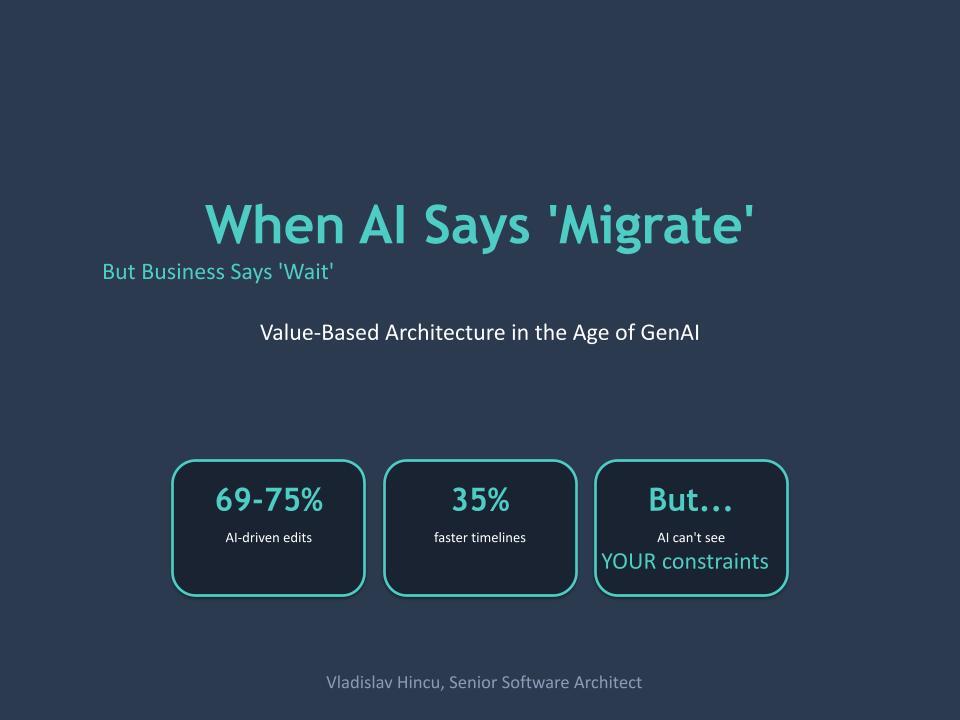
Vladislav Hîncu’s session tackled a very current architectural dilemma: AI tools can now analyze large codebases, suggest modernization strategies, estimate migration plans, and produce recommendations much faster than traditional review processes — but that speed does not mean those recommendations are automatically right for the business.
The talk began with a balanced assessment of what GenAI can already do well in architecture and modernization work. It can parse large systems, identify patterns, classify architecture styles, suggest migrations, estimate technical effort, and compare certain trade-offs quickly. In other words, AI has become a powerful technical advisor. But the central message of the talk was that these tools still cannot see what matters most in many enterprise decisions: the business model, operational realities, regulatory obligations, local constraints, political dynamics, or the hidden assumptions that make one architecture viable and another dangerous.
To illustrate that gap, Vladislav shared a detailed retail example. An AI architecture tool analyzed a legacy point-of-sale system and recommended a full cloud migration with a clean microservices-based architecture. On paper, the recommendation looked excellent: better performance, lower infrastructure costs, and a shorter implementation timeline. But one crucial question changed everything: what happens when a store loses internet connectivity? For a global retailer operating across many countries and conditions, stores needed to continue functioning offline. A cloud-only architecture would have created a direct business risk — stores would become unable to process transactions during outages. The talk made the point vividly: a technically impressive migration recommendation can still be catastrophic if it ignores a non-negotiable business invariant.
From there, the session introduced the distinction between ordinary trade-offs and **hard business constraints**. AI tends to frame architecture decisions as optimizations between cost, performance, scalability, and reliability. But not everything is negotiable. Some requirements are hard boundaries: data must stay in a specific region, stores must function offline, a payroll integration cannot simply be replaced, or a latency threshold is tied to the business model itself. These are not just technical preferences. They define whether the business can continue operating.
Another major contribution of the talk was Vladislav’s explanation of **true value**. AI-generated architecture recommendations often highlight expected benefits, but they do not fully account for persistent operational costs, increased complexity, new staffing needs, debugging overhead, distributed failure modes, training burden, or the business cost of losing useful existing capabilities. A migration may look elegant in a slide deck and still become more expensive and more fragile over time. He gave the example of systems broken into dozens of microservices where initial progress looked impressive, but long-term ownership costs and operational complexity eventually outweighed the gains.
To help make these decisions more concrete, the talk proposed a practical framework:
1. identify business invariants before reviewing AI recommendations,
2. check every recommendation against those invariants,
3. calculate full value rather than accepting surface-level benefit estimates.
That framework formed the core of the talk’s argument: AI should be treated as an input into decision-making, not as the final decision-maker.
The audience questions reinforced that theme. One attendee asked how to convince stakeholders that waiting can actually be the riskier option. Vladislav’s answer emphasized documentation and explicit risk framing: architects need to clearly record the constraints, risks, and possible outcomes so that business leaders understand what they are choosing and can own the trade-offs consciously. Another question asked whether AI would eventually replace platform or DevOps engineers. His response was nuanced: AI will likely replace or automate work that follows clear, repeatable patterns, but it will not replace roles centered on judgment and responsibility. Where decisions have business consequences, human accountability remains essential. In response to a final question about the main takeaway from the session, Vladislav summarized the talk as a call for collaboration rather than competition: the architect’s role is evolving from pure technical design into a bridge between AI-generated technical options and business reality.
Overall, this was one of the strongest strategy talks of the conference. It did not reject AI — quite the opposite. It argued that AI is already powerful and useful, but that its recommendations become truly valuable only when filtered through business context, operational constraints, and accountable human judgment.
The presentation is available here.
Vladislav Hîncu’s session tackled a very current architectural dilemma: AI tools can now analyze large codebases, suggest modernization strategies, estimate migration plans, and produce recommendations much faster than traditional review processes — but that speed does not mean those recommendations are automatically right for the business.
The talk began with a balanced assessment of what GenAI can already do well in architecture and modernization work. It can parse large systems, identify patterns, classify architecture styles, suggest migrations, estimate technical effort, and compare certain trade-offs quickly. In other words, AI has become a powerful technical advisor. But the central message of the talk was that these tools still cannot see what matters most in many enterprise decisions: the business model, operational realities, regulatory obligations, local constraints, political dynamics, or the hidden assumptions that make one architecture viable and another dangerous.
To illustrate that gap, Vladislav shared a detailed retail example. An AI architecture tool analyzed a legacy point-of-sale system and recommended a full cloud migration with a clean microservices-based architecture. On paper, the recommendation looked excellent: better performance, lower infrastructure costs, and a shorter implementation timeline. But one crucial question changed everything: what happens when a store loses internet connectivity? For a global retailer operating across many countries and conditions, stores needed to continue functioning offline. A cloud-only architecture would have created a direct business risk — stores would become unable to process transactions during outages. The talk made the point vividly: a technically impressive migration recommendation can still be catastrophic if it ignores a non-negotiable business invariant.
From there, the session introduced the distinction between ordinary trade-offs and **hard business constraints**. AI tends to frame architecture decisions as optimizations between cost, performance, scalability, and reliability. But not everything is negotiable. Some requirements are hard boundaries: data must stay in a specific region, stores must function offline, a payroll integration cannot simply be replaced, or a latency threshold is tied to the business model itself. These are not just technical preferences. They define whether the business can continue operating.
Another major contribution of the talk was Vladislav’s explanation of **true value**. AI-generated architecture recommendations often highlight expected benefits, but they do not fully account for persistent operational costs, increased complexity, new staffing needs, debugging overhead, distributed failure modes, training burden, or the business cost of losing useful existing capabilities. A migration may look elegant in a slide deck and still become more expensive and more fragile over time. He gave the example of systems broken into dozens of microservices where initial progress looked impressive, but long-term ownership costs and operational complexity eventually outweighed the gains.
To help make these decisions more concrete, the talk proposed a practical framework:
1. identify business invariants before reviewing AI recommendations,
2. check every recommendation against those invariants,
3. calculate full value rather than accepting surface-level benefit estimates.
That framework formed the core of the talk’s argument: AI should be treated as an input into decision-making, not as the final decision-maker.
The audience questions reinforced that theme. One attendee asked how to convince stakeholders that waiting can actually be the riskier option. Vladislav’s answer emphasized documentation and explicit risk framing: architects need to clearly record the constraints, risks, and possible outcomes so that business leaders understand what they are choosing and can own the trade-offs consciously. Another question asked whether AI would eventually replace platform or DevOps engineers. His response was nuanced: AI will likely replace or automate work that follows clear, repeatable patterns, but it will not replace roles centered on judgment and responsibility. Where decisions have business consequences, human accountability remains essential. In response to a final question about the main takeaway from the session, Vladislav summarized the talk as a call for collaboration rather than competition: the architect’s role is evolving from pure technical design into a bridge between AI-generated technical options and business reality.
Overall, this was one of the strongest strategy talks of the conference. It did not reject AI — quite the opposite. It argued that AI is already powerful and useful, but that its recommendations become truly valuable only when filtered through business context, operational constraints, and accountable human judgment.